
4 THINGS DETERMINE WHETHER AI SUCCEEDS IN YOUR ORGANIZATIon
Most AI initiatives don't fail because of the technology. They fail because of what was missing before the technology was deployed — incomplete data foundations, absent governance, unprepared people, and tools selected without strategy. Our framework addresses all four.
Data Readiness

The quality, accessibility, and governance of the data your AI systems will use — the single most common reason AI initiatives produce unreliable outputs or fail to reach production.
Why Data Matters
AI doesn't create insight — it amplifies patterns in the data it's given. If that data is fragmented across disconnected systems, inconsistently formatted, or missing the provenance tracking that responsible AI requires, no model, no prompt, and no vendor can compensate. Garbage in, garbage out is not a cliché here; it is the most predictable failure mode in enterprise AI.
The challenge most organizations face isn't a lack of data — it's a lack of visibility into what data exists, where it lives, and whether it can actually be used. Data that works well for reporting doesn't automatically work well for AI. AI has different requirements: freshness, completeness, labeling, and access. Meeting those requirements starts with knowing what you have.
There is also a compliance dimension that organizations consistently underestimate. Once data flows into an AI system, questions of provenance, retention, and consent become suddenly important. Sensitive data that is tolerated in a reporting database becomes a material liability inside an AI pipeline. We help organizations understand that exposure before it becomes a problem.
Our Data Review
- Data inventory completeness — do you know what data you have and where it lives?
- Quality standards — is your data clean, consistent, and current enough for AI use?
- Lineage and provenance tracking — can you trace data from source to AI output?
- Access governance — are sensitive data sets protected without blocking legitimate use?
- Data classification — is sensitive, regulated, or proprietary data clearly labeled?
What Good Looks Like
A complete, maintained data inventory. Defined quality metrics with active monitoring. Clear data ownership. Lineage tracking from source to AI use case. Access controls that protect sensitive data and satisfy your compliance obligations without creating bottlenecks for authorized teams.
Common Data Gaps
Organizations discover that data they assumed was AI-ready is either inaccessible to the systems that need it, inconsistent across sources, or missing the governance structures required for responsible AI use. This is almost always discovered during deployment — the worst possible time.
People-CENTRIC AI Readiness

The human side of AI adoption — executive alignment, organizational capability, and the change management that determines whether people adopt AI or quietly work around it.
WHY IT MATTERS
Every time an employee uses an AI tool without a governance framework in place, your organization accepts risk it hasn't explicitly chosen to accept. Data can leave your environment through consumer AI tools. Decisions can be made based on AI outputs that are wrong or biased, without any human review. Compliance obligations can be violated before anyone realizes there's an exposure.
The risk isn't theoretical. Regulatory pressure around AI is increasing in every industry. GDPR, CCPA, HIPAA, and sector-specific frameworks already have implications for how AI is used with personal or protected data — and new AI-specific regulation is arriving. Organizations that don't have governance in place now are building technical debt that will be expensive to unwind later.
Governance isn't about restricting what your teams can do. Done well, it's about giving people a clear framework for what they can do confidently — and protecting the organization when the boundaries of that framework are tested. We help you build governance that enables responsible use, not governance that simply says no.
WHAT WE EXAMINE
- AI acceptable use policy — do employees know what tools are sanctioned and how to use them?
- Risk assessment — have you identified and prioritized your AI-specific risks?
- Hallucination controls — are high-stakes AI outputs reviewed by a human before action?
- Accountability — is there a defined owner for AI decisions and their consequences?
- Audit trails — can you reconstruct what an AI system did, when, and why?
- Regulatory alignment — are your AI practices consistent with applicable law and frameworks?
WHAT GOOD LOOKS LIKE
Documented, enforced AI usage policies. A risk register for each AI use case. Human-in-the-loop review for high-stakes or regulated decisions. A cross-functional AI governance board with clear accountability. Audit trails that satisfy both internal and regulatory review. Regular policy updates as AI capabilities and regulation evolve.
THE GAP WE MOST OFTEN FIND
Shadow AI: employees using consumer AI tools that aren't sanctioned, monitored, or governed. Data is leaving the organization through platforms with no enterprise agreement, no data retention controls, and no audit trail. This is the most common source of AI security incidents — and it's almost invisible until something goes wrong.
AI Governance & Security

The policies, controls, and accountability structures that make AI use safe, compliant, and auditable — and that protect your organization when AI gets something wrong.
Why It Matters
AI doesn't fail because the technology doesn't work. It fails because organizations don't change to accommodate it. People resist tools they don't understand. Leaders don't fund programs they don't own. Teams can't adopt what they haven't been prepared for. The technology is rarely the problem — the organization is.
Our change management approach starts with four questions that need clear answers before any AI deployment begins. What is changing, and why? Who has to change? How must they change? And how can we help them do it? These questions sound simple. Getting honest answers to all four requires genuine engagement across the organization — from the executive suite to the front line. Most organizations skip this work. The ones that don't have a significantly higher rate of successful AI adoption.
Leadership alignment is particularly critical. When executives don't have defined ownership of AI outcomes, AI programs tend to stay in pilot indefinitely. There's no one with the authority to take them to production, no one accountable for results, and no organizational structure to scale what's been learned. We help you build that structure before you need it.
What We Assess
- Executive sponsorship — is there a named owner for AI strategy and outcomes?
- Cross-functional alignment — do stakeholders agree on AI priorities and accountability?
- Workforce AI literacy — do employees understand AI well enough to use it safely?
- Training and upskilling — is there a structured program to build AI capability?
- Change management planning — how will resistance be addressed and adoption supported?
- Adoption metrics — how will you measure whether AI is actually being used and working?
Our Best Practices
A named executive sponsor with defined accountability for AI outcomes. Cross-functional alignment on priorities. A workforce AI literacy baseline with measurable upskilling targets. A change management plan that treats resistance as expected and planned for — not as failure. Regular adoption tracking tied to business metrics.
Common Challenges
One or two AI champions with no organizational structure behind them. The energy exists, the intent is right, but without executive ownership and a governance structure, AI stays in proof-of-concept indefinitely. Every successful pilot needs someone with the authority to say "we're going to production" — and that person needs to exist before the pilot begins.
Systems & Workflows Readiness

The AI use cases you're pursuing, how you've prioritized them against business outcomes, and the vendor governance framework that keeps your tool stack accountable over time.
Why It Matters
The most common mistake we see in enterprise AI isn't a technical failure — it's a sequencing failure. Organizations acquire tools before they've defined the problem. They evaluate vendors on what demos well rather than what their business actually needs. They measure success by adoption rate rather than business outcome. The result is high tool spend, low measurable impact, and a growing skepticism about whether AI delivers at all.
The antidote is straightforward but requires discipline. Start with a specific business problem. Define what success looks like before you look at a single vendor. Build your evaluation criteria from your requirements, not from a vendor's feature list. Then govern the tools you select with the same rigor you'd apply to any other critical business system — ongoing monitoring, regular review, and SLAs that hold vendors accountable for the outcomes they promised.
Vendor governance is also where organizations most often underinvest. The tools you select today will generate data, influence decisions, and create dependencies that compound over time. The terms you agree to when you sign a vendor contract shape your options years into the future. We help you evaluate that exposure before you commit — and build governance frameworks that protect your options as AI capability continues to evolve.
What We Cover
- Use case inventory — have you defined and documented the specific problems AI will solve?
- Prioritization — are use cases ranked by business value, feasibility, and risk?
- Success criteria — do you have defined, measurable outcomes for each AI initiative?
- Vendor evaluation — do you assess vendors against security, compliance, and data handling?
- Contractual safeguards — do your SLAs include AI-specific terms and accountability clauses?
- Performance monitoring — how do you assess vendor tools after deployment?
Best Practices
A prioritized roadmap of 2–5 AI use cases with defined owners and measurable success metrics. A structured vendor evaluation framework covering security, compliance, data handling, and ethics. SLAs with AI-specific performance, explainability, and accountability terms. A regular vendor review cadence tied to performance data and evolving requirements.
Common Gaps
Use cases selected because a vendor ran a compelling demo — not because the business defined a problem that needed solving. Without clear success criteria established before deployment, there's no way to evaluate whether the tool is working, no basis for holding vendors accountable, and no rational framework for deciding whether to expand, modify, or exit.
Why the framework works
ADDRESSING ONLY ONE OR TWO PILLARS IS HOW AI PROGRAMS STALL
Pillars 01 + 02
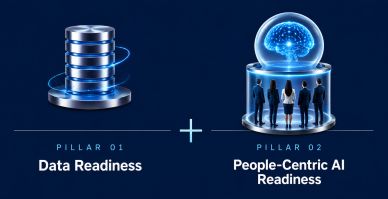
Data without people creates unused capability.
A strong data foundation without workforce readiness means AI systems exist but go unused, misused, or quietly bypassed. Technical capability only delivers when the people expected to use it are prepared to do so.
Pillars 02 + 03
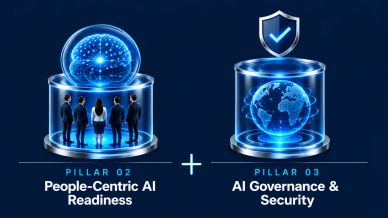
People without governance creates adoption without accountability.
Enthusiastic, capable teams adopting AI without a governance framework take risks the organization hasn't sanctioned. Shadow AI, data exposure, and compliance gaps multiply in exactly the environments where people are most eager to experiment. Energy without structure creates liability.
Pillars 03 + 04
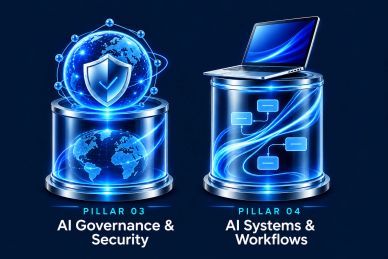
Governance without systems creates policy without integration.
A governance framework that doesn't extend into how systems are architected and workflows are designed stays on paper. Policies don't protect you if the underlying data flows and integrations weren't designed with those policies in mind.
Pillars 01 + 04

Systems without data creates expensive underperformance.
The most sophisticated AI systems and workflows cannot compensate for a data foundation that isn't ready. Organizations that invest in systems before they invest in data foundations consistently underperform on ROI — and are the most likely to conclude that AI doesn't work for their industry.

Four pillars. One executive layer.
Additional Information
The four pillars describe the organizational capabilities required for AI readiness. But there is a dimension that shapes the performance of all four: executive leadership and strategic alignment.
Without a clearly articulated AI vision, defined ownership, and consistent strategic direction from leadership, organizations consistently find that even well-built operational foundations stall. Departments pursue disconnected priorities. Investments multiply without shared direction. Governance expectations diverge between functions.
Organizations where senior leaders are aligned on AI strategy, willing to model AI use, and accountable for AI outcomes scale their programs four times more effectively than those where AI is treated as a technology initiative without executive ownership.
Executive alignment
A unified AI vision and ownership structure
Without shared direction, pillar investments compete rather than compound.
Strategic prioritization
AI as a business strategy, not a technology project
Organizations that frame AI through a business lens outperform those focused on platform selection.
Operating model
Formal governance and accountability structures
AI initiatives with formal operating models scale 4× more effectively than those without executive-level governance.
Learn More
This is a content preview space you can use to get your audience interested in what you have to say so they can’t wait to learn and read more. Pull out the most interesting detail that appears on the page and write it here.
Determine Your AI Priorities in 5 Minutes

Quickly assess your AI readiness across key pillars with personalized insights and next steps.
At AiXIAM, we deliver tailored AI solutions, strategic planning, and digital transformation support. Explore our services to accelerate your business growth.